As businesses grow, industry trends and changing customer expectations can reshape how they build teams. They wonder how to add the people and expertise needed to support that growth. Increasing customer interactions, administrative demands, and sales activity can quickly stretch existing teams.
When it comes time to choose between outsourcing vs hiring internally, it quickly becomes clear that it is more than filling open roles. The decision affects costs, communication, culture, scalability, and a company’s long-term success.
Most businesses assume there are only two options. You could add full-time employees and manage the function entirely internally, or outsource and share certain staffing responsibilities with an external partner.
However, there isn’t a single right answer. For many small businesses and growing organizations, a hybrid approach is best. Keeping functions that need the most direct oversight in-house while outsourcing functions that integrate well remotely can provide the right balance of control, flexibility, and cost.
Cost is only one factor. Communication, operational needs, management capacity, and long-term business goals should carry just as much weight. At Elite Sense, we believe that successful staffing is more than filling a position within budget. Success depends on communication quality, cultural fit, and continuity.
What Is Internal Hiring? Building a Dedicated Team
Internal hiring means adding full-time employees to your organization. They work directly for your company, become part of your team, and help build your company culture over time.
Full time employees often develop a deep understanding of your products, customers, and processes. They also become immersed in your company’s values, helping businesses build a team that shares the organization’s culture, communication standards, and long-term goals.
However, hiring internally involves more than paying a salary.
Additional costs include:
- Payroll taxes and employee benefits
- Recruiting and onboarding
- Training and equipment
- Management time
- Replacement costs if a new hire leaves
Research shows the total cost of an employee is often 1.25 to 1.85 times their base salary once you include employee benefits, insurance, paid leave, and taxes. A position with a $50,000 salary may actually cost between $80,000 and $92,500 each year.
Recruiting is also time-consuming and requires significant investment. Hiring a new employee costs an average of nearly $4,700, while specialized positions can cost $10,000–
$25,000 or more. Onboarding typically adds another $4,000–$5,000, not including leadership time.
Replacing an employee can cost 1.5 to 2 times their annual salary when you factor in recruiting, onboarding, and lost productivity. The average employee now stays with one company for just over four years, making turnover an expected cost rather than an exception.
Hiring in-house also creates more administrative overhead than outsourcing. Recruiting, payroll, performance management, compliance, and employee support all require ongoing leadership attention. Despite these responsibilities, hiring in house can be a better fit when the role requires direct internal authority, management, or access.
For example, roles that require:
- Direct strategic decision-making authority
- A high degree of internal management and oversight
- Regular onsite collaboration or physical presence
- Direct responsibility for highly sensitive intellectual property
- Deep involvement in proprietary processes or business-critical decisions
These requirements can make hiring in house the right choice for certain roles. For others, particularly roles that integrate well into remote workflows, outsourcing may offer a different set of advantages.
What Is Outsourcing? Common Outsourcing Functions Explained
Outsourcing is the practice of contracting external partners to perform specific business functions instead of hiring employees internally. It means working with an external partner or external providers to complete those functions instead of expanding your internal headcount.
Organizations commonly outsource:
- Customer support
- Administrative tasks
- Repetitive tasks
- IT support
- Sales support
- Marketing
- E-commerce operations
Outsourcing gives companies access to specialized expertise and diverse skill sets, a broader global talent pool, and the flexibility to scale with changing demand.
Depending on the provider, outsourcing may also reduce administrative responsibilities because payroll, HR, employee support, and equipment are often handled externally.
Outsourcing is about who does the work, not where they work. If you’re also weighing building your team abroad, our guide to outsourcing vs offshoring explains the difference.
Not Every Outsourcing Model Is the Same
Many organizations compare outsourcing vs hiring internally as though every outsourcing provider offers the same service. In reality, there are several approaches.
Traditional Outsourcing
Traditional outsourcing focuses on completing specific tasks or delivering a defined service.
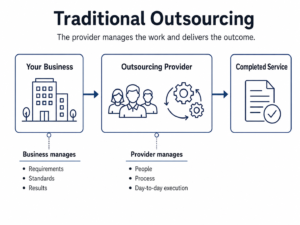
The provider manages the work while your company evaluates the results. This model works well for repetitive or other specialized tasks such as IT maintenance, accounting, or customer support.
Its strengths include predictable service fees and reduced management responsibility. However, because the relationship is primarily transactional, employers may have less day-to-day control.
Embedded Remote Staffing
Embedded remote staffing is different.
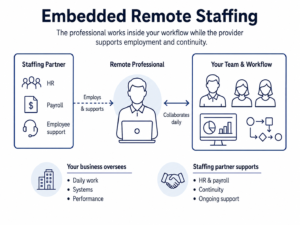
Instead of completing work independently, skilled professionals become part of your existing workflow. They use your systems, report to your managers, and work closely with your existing team.
The staffing provider continues managing HR, payroll, and employee support while your business maintains greater operational oversight.
This model combines many of the benefits of outsourcing with the collaboration normally associated with an in-house team.
Recruitment Partnerships
Recruitment partnerships help companies hire in-house rather than provide ongoing staffing.
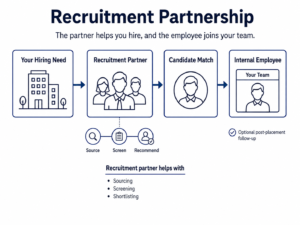
The partner sources, screens, and recommends qualified candidates. Some models remain involved through onboarding to help the hire succeed.
Internal Hiring vs Outsourcing: At a Glance
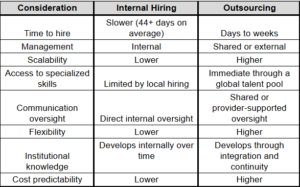
Businesses should also consider collaboration practices, management capacity, long-term knowledge, and how quickly they need to respond to changing business needs.
An internal team often benefits from spontaneous conversations and faster feedback. Outsourced teams can achieve similar results when expectations, ownership, and onboarding are clearly defined.
Maintain Company Culture Through Communication and Continuity
Strong working relationships keep organizations running smoothly. They improve the customer’s experience, support teamwork, and help teams resolve issues quickly. When expectations are unclear, or information isn’t shared effectively, customer trust declines, handoffs become inefficient, and operations become inconsistent.
For organizations serving multilingual markets or filling customer-facing roles, service quality often matters more than labor costs. That’s why it’s critical to consider your options.
An internal team naturally benefits from regular interaction with leadership and coworkers. Employees become familiar with the company’s values, customers, and day-to-day operations. Over time, they develop a deeper understanding of your company, helping them deliver more consistent results.
Outsourcing often has a reputation of lacking in this area; however, these concerns often come from poor implementation rather than outsourcing itself. They also show up far more often in transactional, traditional outsourcing arrangements than in embedded, managed staffing models built around ongoing communication. Common challenges include:
- Limited overlap across different time zones
- Weak onboarding and unclear expectations
- Poor documentation and unclear ownership
- High turnover among outsourced teams
- Inconsistent communication with customers
Keep in mind that even highly skilled professionals can struggle without enough business context. Technical ability alone does not prepare someone to manage customer relationships, resolve complex issues, or represent your brand effectively. Well-designed outsourcing partnerships address these risks through structured onboarding, ongoing support, clear communication, and cultural alignment.
The same is true in reverse: internal teams perform well when they handle recruiting, onboarding, management capacity, and retention deliberately. Just because the team sits in-house doesn’t mean they’ll perform well.
Verdict:
 Internal teams have the advantage of daily proximity, but proximity alone doesn’t guarantee strong communication or accountability. Internal teams also face their own risks around turnover, knowledge loss, and inconsistent management as they grow.
Communication, accountability, and continuity matter more than where a team works. In a managed staffing model, accountability is shared among the client, the professional, and the staffing provider, which allows remote professionals to perform much like an in-house team.
Cost and Budget Impact
Every hiring decision affects more than payroll.
Growing businesses must balance staffing costs with cash flow, growth goals, and leadership capacity. A delayed hire can slow projects, increase pressure on existing employees, and pull leaders away from strategic work.
What happens to staffing costs as needs change?
When hiring in house, many costs continue regardless of workload. These include:
- Salaries
- Employee benefits package
- Payroll taxes
- Software and equipment
- Office expenses
- Training
- Management time
Plus, if a hire doesn’t work out, replacement costs can be substantial.
Outsourcing changes this cost structure by replacing many fixed expenses with more predictable operating costs.
Depending on the provider, you can also avoid many of the hidden fees associated with recruiting, onboarding, equipment, and HR administration. Outsourcing can reduce:
- Routine office tasks
- Equipment and infrastructure costs
- HR responsibilities
- Management overhead
Many providers also handle payroll administration, employee support, and benefits, letting leadership focus on core competencies instead of administrative tasks. While cost efficiency remains a primary reason organizations outsource, Deloitte’s 2024 Global Outsourcing Survey found that organizations increasingly prioritize skilled talent, agility, and value creation when selecting outsourcing partners. As a result, many businesses find the greatest long-term value comes from operational flexibility, access to specialized expertise, and preserving leadership time.
For example, a role costing $80,000–$92,500 annually when hired internally in the United States may cost $13,680–$31,680 through certain remote staffing models. Actual savings vary by role and location, but lower associated costs often let businesses invest more in technology, customer experience, or growth.
Verdict:
Cost is a real factor, but it shouldn’t be the deciding one. Long-term value depends on the full cost of staffing, including management demands, retention, continuity, and the resources required to support the team effectively.
Outsourcing tends to reduce fixed costs for employers experiencing rapid growth or changing workloads. This is especially true with embedded remote staffing solutions that prioritize communication fit and long-term integration, not price alone.
In house hiring may be more cost-effective when a business already has the management capacity, infrastructure, and consistent workload to support the role directly.
Speed and Scalability: Responding to Business Growth
Business growth rarely follows a hiring schedule.
Customer demand can increase unexpectedly, and new markets may open quickly. Businesses often need to respond to growth needs before the next internal hiring cycle can be completed. If hiring cannot keep pace, growth slows, and existing teams become overloaded.
Scaling up can take time. According to research from The Josh Bersin Company and AMS, the average time to fill roles reached 44 days in 2023. Specialized technical roles often take even longer. Outsourcing can shorten that timeline by giving businesses access to established recruiting processes and talent networks, while the right partner also maintains standards for communication and role fit.
Both approaches require planning.
Successful outsourcing depends on clear processes, documentation, and ongoing communication. Hiring internally requires recruiting, onboarding, benefits administration, equipment, and compliance before an employee becomes fully productive.
The difference is speed and scalability.
Outsourcing can help businesses scale services or team capacity as it grows because the provider already has recruiting processes, talent networks, and employment infrastructure in place. This can be especially valuable when a business is:
- Experiencing sustained growth that exceeds internal hiring capacity
- Building or expanding a function quickly
- Entering a new market or region
- Hiring multiple roles at once
- Accessing specialized or multilingual talent
- Expanding headcount without equivalent growth in HR infrastructure
Verdict:
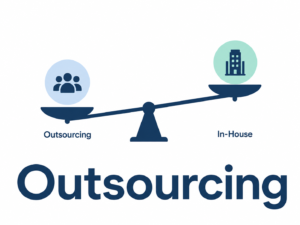 When speed is critical, outsourcing has a clear advantage. Established recruiting processes, broader talent networks, and existing employment infrastructure let businesses add capacity faster.
Hiring in house offers direct control over the process, but generally takes more time to recruit, onboard, and operationalize new employees.
Access Specialized Expertise When You Need It
One of the biggest advantages of outsourcing is immediate access to specialized skills.
Building those capabilities within an in-house team often takes months of recruiting, training, and onboarding. It also depends on local hiring conditions, which can make it difficult to find multilingual professionals or candidates with niche technical skills.
An external expert can provide experienced professionals much faster.
Benefits often include:
- Access to diverse skill sets that are difficult to hire locally
- A broader global talent pool
- Experienced professionals with established workflows
- Existing tools and systems
- Faster onboarding and implementation
For many businesses, outsourcing fills capability gaps that would be expensive or impractical to build internally.
Expertise Alone Isn’t Enough
Technical ability is only one part of successful staffing.
Roles such as:
- Customer support
- Technical support
- Sales support
- Executive assistance
- E-commerce operations
- Customer success
depend just as much on clear customer interactions, teamwork, and business context.
The strongest outsourced partners share several characteristics:
- Clear performance expectations
- Defined escalation processes
- Thorough onboarding
- Ongoing support after placement
- Regular check-ins and performance reviews
These practices help remote professionals become part of the business rather than remain outside vendors.
The Elite Sense Approach:
At Elite Sense, we look beyond technical qualifications when matching remote professionals. We consider communication skills, cultural alignment, and the role’s context, then provide ongoing support to help specialized, multilingual talent integrate effectively and contribute over time.
Scaling a Dedicated Team Without Building Full Infrastructure
Growing businesses don’t always need to build an entire internal function from scratch to get the support they need. Sometimes a streamlined approach will suffice.
Some examples include when a business is:
- Expanding into a new market
- Building a dedicated customer support, admin, or sales team
- Adding specialized roles without the infrastructure to hire, train, and manage internally yet
- Growing faster than internal HR and recruiting capacity can keep up with
- Looking to expand a function’s headcount without expanding its management overhead at the same rate
Building that capacity entirely in-house means recruiting, onboarding, payroll, benefits administration, and ongoing management. Plus, all of this happens before a new hire is fully productive.
A managed staffing model, such as embedded remote staffing, lets a business build and expand a dedicated team without taking on that full recruitment, HR, payroll, and administrative infrastructure internally. Businesses gain:
- A team that grows with the business, not a temporary stand-in
- Reduced internal HR and recruiting burden
- Structured onboarding and management already in place
- The ability to scale the team up or down as the business evolves
The Continuity Trade-Off of Outsourcing
Every staffing model involves trade-offs.
Outsourcing also creates some dependence on external providers. However, this risk is greatest in transactional and traditional outsourcing and is considerably reduced in well-structured embedded staffing models. If a provider changes personnel or ends a contract, operations can be disrupted unless it documents knowledge and clearly defines responsibilities.
Businesses can reduce that risk by investing in:
- Process documentation
- Knowledge sharing
- Defined roles and responsibilities
- Regular performance reviews
- Transition planning
The most successful outsourcing relationships continue long after onboarding. Ongoing support, regular follow-up, and shared accountability help maintain consistent service as the business grows. The same is true internally: leadership keeps investing in the strongest teams through training, feedback, and career development, not just the ones hired well.
Verdict:
Both internal and outsourced teams can provide long-term continuity when knowledge, responsibilities, and transitions are managed well.
Hiring internally does not eliminate turnover or knowledge loss, just as outsourcing does not inherently create them. In either model, success depends on documentation, integration, and ongoing support.
Internal Hiring vs Outsourcing: Which Should You Choose?
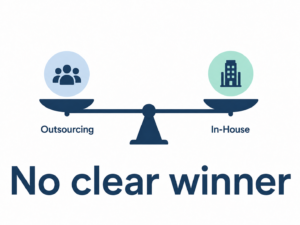
There is no universal answer to outsourcing vs hiring internally. The right decision depends on your business goals, growth stage, and the role itself.
Choose Internal Hiring If:
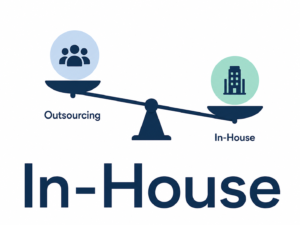
- The role includes strategic decision-making authority
- The work involves highly sensitive intellectual property
- The role requires someone to be physically present on site.
- The business needs direct internal management of the role
- The work is closely tied to proprietary systems or processes
Choose Outsourcing If:
- You need access to a broader global or multilingual talent pool
- Leadership needs to focus on the core business
- You need specialized skills quickly
- You’re expanding into new markets
- The work can be integrated into your existing systems and workflows without requiring an onsite presence.
The Best Answer Is Often a Hybrid Model
For many organizations, the strongest staffing strategy combines both approaches.
Keep functions that require an onsite presence, direct authority, or the highest IP sensitivity in-house, while outsourcing those that integrate well remotely, such as:
- Customer support
- Administrative work
- E-commerce operations
- Sales support
- Multilingual communication roles
This approach lets businesses maintain direct internal management where needed while using outsourced talent where remote integration and shared staffing support make sense. You’ll maintain direct oversight where needed while gaining access to specialized expertise and the ability to adapt as business needs evolve and scale efficiently.
Neither hiring internally nor outsourcing can compensate for broken internal processes. If expectations, workflows, roles, and responsibilities are unclear, external teams will inherit those same problems.
The most successful business leaders treat staffing as an ongoing business decision—not an either-or choice. They regularly evaluate which functions create the most value internally, which are better supported by external specialists, and how those decisions should change as the company grows.
Every organization has different priorities. Whether you’re considering hiring in-house, outsourcing, or a hybrid model, Elite Sense Consulting provides consultative guidance to help businesses build staffing strategies that support communication, operational continuity, and sustainable growth.
Schedule a free consultation to discuss your hiring goals and identify the staffing approach that best supports your business.
————————————————————————————————————————–
Hiring FAQs
Can You Combine In-House Hiring and Outsourcing?
Yes. Many businesses achieve the best results with a hybrid model.
Success depends on more than dividing responsibilities. Internal and outsourced teams need shared workflows, clearly defined roles, and consistent expectations.
When you treat outsourced partners as an extension of the business rather than temporary vendors, they can deliver long-term value alongside your internal team.
When Should a Business Reconsider Its Staffing Model?
Whenever there’s growth, it’s a good idea to reconsider your staffing model. Many small businesses begin by outsourcing and later bring functions in-house; just as often, established companies move a previously internal function to a managed staffing partner because they need better scalability, specialized expertise, access to global talent, or reduced management overhead.
Signs it may be time to bring a function in-house include:
- The role requires a deep understanding of your business.
- Workload is stable.
- Leadership can manage a larger team.
- Long-term outsourcing costs approach the cost of hiring internally.
- The role involves increasingly sensitive data, proprietary processes, or strategic decision-making.
What Are the Biggest Risks of Each Approach?
Both options involve trade-offs. The outsourcing risks below are most associated with transactional, traditional outsourcing arrangements. A managed, embedded staffing model is built specifically to reduce them.
Internal Hiring Risks
- Higher fixed costs, plus turnover and loss of institutional knowledge as the team grows
- Slower response to changing market conditions
- Expensive hiring mistakes
- Ongoing HR and administrative responsibilities
Outsourcing Risks
- Misaligned expectations
- Loss of business knowledge
- Unclear roles and responsibilities
- Poor cultural alignment
- Overreliance on one provider
- Outsourcing poorly defined processes
These risks do not make outsourcing ineffective. They reinforce the importance of choosing the right partner.
When Should a Business Consider Outsourcing a Function That Is Currently In-House?
A business may consider outsourcing when a function can be managed effectively remotely, the company needs more room to scale, or the right talent is difficult to find locally.
Outsourcing can give businesses access to a broader talent pool while reducing the need to expand internal recruiting, HR, and administrative infrastructure at the same pace as the team.
It can be especially useful for roles that integrate well with existing systems and workflows, including specialized or multilingual positions that may be harder to fill locally.