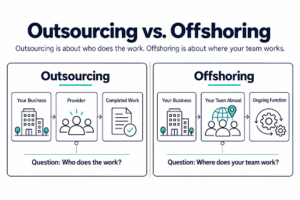
For a growing business looking to add capacity without overloading its existing team, the choice between outsourcing and offshoring matters. Is offshoring the same as outsourcing? Not quite. Outsourcing means a third-party provider handles a task or business function for you. Offshoring means moving work to your own team in another country. The two can overlap (you can outsource to an overseas provider). Still, the distinction is simple: outsourcing is about who does the work, and offshoring is about where your people sit.
Most comparisons treat the difference as a trade-off between control and speed. That is a fair way to look at standardized, easy-to-specify work. However, for communication-critical work, where people speak to your customers, prospects, or your own team every day, a better question is which arrangement keeps communication clear and the same dedicated people in place over time.
The short answer: Outsourcing is about who does the work, and offshoring is about where it happens. Many businesses combine the two by working with an outsourcing partner whose people are based abroad. Whichever setup you choose, what decides whether it works is less the label than how well the people communicate and whether they stay with you over time.
How Does Outsourcing Look For a Growing Business?
Outsourcing means contracting an external company to handle a business function. A marketing agency running your paid ads, a BPO handling your support desk, and an accounting firm keeping your books are all forms of outsourcing. It can happen domestically or internationally. The defining feature is that the provider employs, trains, and directs the people doing the work, and you pay for an agreed output.
Some roles are naturally made for outsourcing. In Clutch’s 2019 survey of 529 US small business owners and managers, small businesses most commonly outsourced finance and accounting, IT services, and digital marketing. Many online stores also outsource e-commerce customer service and catalog upkeep. Deloitte’s 2024 Global Outsourcing Survey of more than 500 executives found that back-office outsourcing remains common, with organizations increasingly turning their attention to front-office capabilities such as sales and marketing.
What the outsourcing model does well:
- Specialized capability. A provider can bring expertise that would take months to build internally, such as a niche CRM platform, data analytics, or language coverage.
- Less HR administration. The provider handles recruitment, payroll, and benefits for the people doing the work.
- Flexible scope. Contracts can be short-term or project-based, and capacity can rise and fall with seasonal peaks.
- A quicker start. Outsourcing generally sets up faster than building your own team abroad.
The trade-off can be distance. How much depends on the provider: some rotate people across clients and follow set scripts, while others keep a dedicated team close to you. For standardized work, either can be fine. When someone speaks for your brand, that difference matters.
What Is Offshoring and How Does It Differ?
Offshoring means building a team in another country whose members are, organizationally, your people. Examples include a customer success team in the Philippines led by your own team leads, or a finance operations team on your payroll abroad. Unlike outsourcing, you directly decide on hiring, training, and culture.
The legal structures vary. You can set up your own local entity (a subsidiary or branch), or use an employer of record (EOR) that legally employs people on your behalf. At the same time, you direct their work, or engage a build-operate-transfer partner who stands up the team and later hands it over. Each differs in setup cost, speed, and compliance burden.
Typical functions to offshore include ongoing customer support, finance operations, back-office processing, and product engineering.
The trade-off is that everything falls to you: recruiting in a market you may not know, meeting local labor and tax rules, and leading a distributed team day to day.
The Risk Both Models Share: Communication
Comparisons of outsourcing and offshoring usually stop at cost and control. Sourcing isn’t the typical problem; they fail in the first 90 days, once daily communication begins, and again when someone who understood your business leaves.
A language barrier is the most visible part of the problem, but it is rarely the whole story. Fluency is the entry requirement, but it doesn’t prevent situations such as:
- Someone who speaks the language well but misses tone, context, or the moment to escalate.
- A provider’s script replacing your brand’s voice.
- Feedback that passes through an account contact before it reaches the person doing the work.
- Knowledge that leaves when someone leaves, and a replacement starts from zero.
Each model exposes you to this differently. With outsourcing, you rarely choose the people or get to know them. This means team changes can go unnoticed until quality drops. With offshoring, the people are yours, but you also own the task of judging communication in an unfamiliar hiring market and sustaining it across distance and time zones.
Whichever model you are considering, you can expose your risk by asking these four questions:
- Who assesses how a person communicates before they start?
- Will the same people stay on your work, and what happens when someone leaves?
- Do they work inside your tools and channels, or through the provider’s?
- Who notices friction early, and who acts on it?
An Alternative to Building Your Own Offshore Team
Elite Sense connects businesses with remote professionals who work within their existing teams and workflows. We handle talent matching, onboarding, and ongoing support, so businesses can access international talent without building offshore operations or managing the associated HR responsibilities.
Where Elite Sense Sits
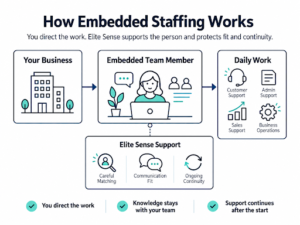
Many businesses would call what Elite Sense does outsourcing, and that’s fair. We are a long-term partner built around communication. Depending on what a client needs, we either run a function for them or embed professionals directly in their team, inside their systems and workflows.
Either way, we assess our multilingual Lebanese professionals for communication standards, cultural alignment, and working style before any introduction, and we stay involved afterward to address friction early and maintain continuity. We support customer service, sales, executive and administrative work, e-commerce, creative and technical functions, and specialist work such as financial analysis. It’s not just outsourced; it’s embedded and supported.
Language fluency is an important part of communication assessment. A business that serves customers in both English and French, as many Canadian companies do, needs to confirm fluency in advance, not assume it. But language is one criterion among several. Day to day, what matters is whether the person communicates as clearly and professionally as a colleague in your own office would.
Embedded staffing works best as a partnership. It asks for hands-on involvement from your side: sharing context, giving feedback, and working alongside the people as part of your team. If you would rather hand a function over entirely and have it run for you, a fully outsourced arrangement may suit you better. Elite Sense offers both, and in our first conversation, we’ll figure out which one fits your work.
Outsourcing vs Offshoring vs Embedded Staffing at a Glance
The three models differ mainly in who directs the work and who carries the communication risk.
| Outsourcing | Offshoring | |
| What it means | A third-party provider handles a task or function | Work moves to your own team in another country |
| Who employs the people | The provider | Your business, directly or through an employer of record |
| Who handles hiring, payroll, and compliance | The provider | Your business |
| Who directs the daily work | Depends on the arrangement: the provider, your team, or both | Your business |
Choosing the Model That Fits
The labels matter less than three questions: who directs the work, who keeps the knowledge, and how communication is protected over time. Outsourcing and offshoring can both answer them well, and many businesses use a mix. The difference is a partner who treats communication and continuity as part of the job.
If you are weighing these options for a customer-facing or collaboration-heavy function, Elite Sense can help. Book an introductory call to talk through which setup fits your work. If hiring at home is also on the table, our guide to outsourcing vs. hiring internally covers that comparison.
———————————————————————————————————————————–
Frequently Asked Questions About Outsourcing vs. Offshoring
What are early warning signs that our current model (outsourcing or offshoring) is no longer right?
There are many signs. Watch for rising error rates without a clear cause, disputes between internal and external teams over who is responsible for what, or costs rising without matching value. If provider turnover is degrading service quality, or your offshore team is taking more leadership time than the function warrants, reassess the model.
How should a growing business start: pilot project or full-function move?
Start with a tightly scoped pilot. That might be support inquiries for one product line with a provider for 90 days, or one or two people embedded in a single function. Measure response times, quality, communication clarity, internal time saved, and actual vs. projected cost. Moving a whole function at once makes problems harder to diagnose.
Is embedded remote staffing a form of outsourcing?
Many businesses think of it that way, since a partner finds, assesses, and supports the people. The difference is that they work within your team and tools, and the partner stays involved long-term to protect fit and continuity.