Every customer interaction with your support team shapes confidence in your brand, especially for ecommerce companies. That’s why choosing the right support provider for your online store is more than just another procurement task. It can also directly determine whether you build or erode customer trust at scale.
Your choice of an ecommerce support provider impacts brand trust. That provider becomes your brand’s voice in high-stakes moments such as lost shipments, refund disputes, and damaged products. These critical interactions shape customer satisfaction, affect repeat purchases, and can end long-term relationships.
Prioritizing a good experience can pay off. Salesforce Research has found that 91% of customers are more likely to repurchase after exceptional customer service. Customers also consistently say they’ll spend more with companies known for providing excellent customer service.
A good customer experience can separate a growing brand from a shrinking one. That’s why building customer trust deserves the same rigor you’d apply to any other growth decision.
The right provider protects customer confidence. They respond with your brand’s voice and values, and give you measurable data to prove it. The wrong one creates inconsistency, exposes sensitive information, and quietly damages the customer loyalty you worked hard to earn.
Do you know how to choose? This article walks through the criteria, benchmarks, and practical questions you need to evaluate before signing with a provider, so that every support touchpoint strengthens your brand reputation in today’s competitive market rather than undermining it.
Your eCommerce Support Provider Is a Brand-Trust Decision.
Every support interaction either reinforces or weakens the promise your brand makes to online shoppers. When a customer contacts you about a missing package, a defective item, or an unclear charge, the agent on the other end is effectively your company. Their tone, speed, accuracy, and empathy determine whether that customer becomes a repeat customer or writes a negative review that steers potential customers away.
The stakes are real and growing. According to Sift’s Q4 2025 Digital Trust Index, retail ecommerce chargeback rates climbed roughly 233% from Q1 to Q3 2025, driven in part by “refund hack” tutorials spreading across social media platforms. Separately, last-mile delivery problems are a leading source of shopper frustration across the industry. That’s when something goes wrong in transit, and consumers overwhelmingly blame the brand, not the carrier. These moments of friction, if handled poorly, lead to social media backlash, negative online reviews, and a measurable drop in repeat business.
Outsourcing support without clear trust safeguards introduces hidden liabilities. Agents may grant inappropriate access to customer data, apply inconsistent refund policies across channels, or use a tone of voice that feels impersonal and corporate. Customer confidence is fragile, and it extends from the moment someone decides to shop online through every support exchange that follows.
Clarify Your Brand-Trust Requirements Before You Shortlist Vendors
Many ecommerce brands jump straight to vendor demos without first defining what “trust” actually requires for their business. The result is a provider that meets cost or capacity targets but fails in the moments that matter most. Before issuing an RFP, run a short internal audit.
Map trust expectations across three phases:
Pre-purchase:

Can online consumers get fast answers to sizing, compatibility, or shipping questions? Are product descriptions clear? Is pricing transparent, with no hidden fees? Customers expect estimated delivery times before they purchase online. Does it take long to browse the site? A slow-loading site undermines brand confidence before support ever gets involved.
Purchase/checkout:

Is the checkout experience on your ecommerce site user-friendly? Do you clearly signal secure online transactions so customers feel reassured that their credit card details are handled safely? Does the contact page display enough information to reassure new customers?
Baymard Institute’s checkout research found that not trusting a site with their payment information is one of the top reasons shoppers abandon checkout, followed by unexpected costs.
Post-purchase:

Can existing customers easily reach support? Are return policies straightforward to understand? What about clear shipping and return policies? Confusion can easily erode brand trust.
Don’t forget agent quality. Your agents are your final defense. Those who respond promptly and with empathy, and communicate transparently throughout, can turn brand uncertainty into confidence.
Before you meet with any ecommerce support vendor, make sure you know your:
- Maximum first response time per channel (e.g., live chat under 60 seconds, email under 2 hours)
- Languages supported, and at what level of fluency
- Tone-of-voice rules and how they align with your brand’s credibility
- Refund and return guardrails: full vs. partial refunds, prepaid labels, exception thresholds
- Data-handling requirements: PCI-DSS, GDPR, CCPA, or whichever standards apply to your markets
- SLAs with defined consequences for missed targets
Spell out your brand alignment needs explicitly. Leave no room for assumption. Ecommerce support providers should align with your brand identity in every conversation, not just in the greeting script. That’s done by training agents to match your brand’s voice and values, so the tone customers hear in a support chat feels like the same brand they saw on your product pages.
Tie trust requirements to business metrics so that you can clearly see how support outcomes connect directly to revenue. Poor support resolution quality negatively impacts customer lifetime value. Excellent customer service is one of the clearest levers for moving that number in the right direction. It’s also a key factor buyers cite when deciding whether to trust a new ecommerce store.
Agent Quality, Training, and Brand Voice Alignment
Frontline agents are effectively your brand to every customer they speak with. Their judgment, empathy, and clarity during a difficult conversation can be the difference between a satisfied customer who returns and a frustrated one who tells others to avoid your online store. Train agents to match your brand’s voice and values from day one before they’re ever assigned to a ticket.
A robust training program should include:
- Structured onboarding: New agents shadow experienced team members, receive product certifications, and pass assessments before handling live tickets.
- Seasonal refreshers: Before peak periods, run focused training on handling delays, supply-chain issues, policy enforcement, and escalation paths.
- Brand voice guidelines: Provide concrete examples such as acceptable greetings, how to apologize without deflecting, and phrases to avoid. Always favor transparent communication over deflection.
Ask for samples. Vendors may provide real training materials (with sensitive information redacted) or sample chat or call transcripts from their e-commerce work. Look for whether agents confirm order details, acknowledge customer emotions, provide clear next steps, and follow brand policy consistently.
For the best results, ask how agents get matched to your account in the first place. A provider that assesses communication style, cultural fit, and working style before introducing someone to your team solves a different, harder problem than one that simply assigns the next person in the queue. This type of attention shows in every customer inquiry.
Elite Sense evaluates more than technical capability.
We consider communication style, language fluency, cultural alignment, and how each person will fit into your existing team and customer experience.
Language coverage matters beyond the basics, too. A French customer may expect a particular conversational register while German customers tend to value precision and directness. Native or near-native fluency prevents the kind of miscommunication that quietly erodes confidence in your brand over many small interactions rather than one dramatic failure.
Omnichannel Coverage and Consistency of Customer Experience
Modern ecommerce brands engage customers across email, live chat, social media channels, marketplace messaging, phone, and sometimes SMS or WhatsApp. Inconsistency between channels can quickly break trust.
A strong provider should cover:
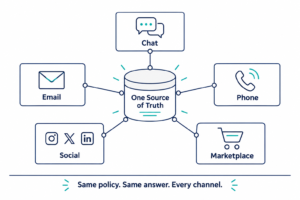
- Website live chat and email
- Phone support for high-value or complex customer inquiries
- Marketplace messaging (Amazon, Walmart)
- Social media platforms including Instagram, Facebook, and TikTok
- Messaging apps relevant to your markets
Underpinning all of this is a unified knowledge base for customer service and client support. This is a single, up-to-date source of truth so the same policies, prices, and return rules apply regardless of channel, shift, or agent.
Verified customer testimonials reinforce all of this from the outside. Consumers consistently report feeling more confident when they shop online with businesses that show visible, positive feedback. Good reviews look good; encourage satisfied customers to leave reviews, and use testimonials on your About Us page and product pages. But they can do much more. They also work quietly in search engines, where fresh, verified feedback helps potential customers find you in the first place. Treat review management as a practice focused on genuinely improving customer engagement.
Service Model, Scalability, and Peak-Season Readiness
Ecommerce brands face sharp volume spikes around Black Friday, Cyber Monday, and back-to-school. Poor support during these periods can permanently damage brand trust. A provider that delivers reliable customer support in normal times but collapses under pressure doesn’t protect your brand; it becomes a liability waiting to surface.
Most vendors will present their service model along a few familiar axes:
| Model | Advantage | Trade-off |
| Dedicated agents | Deeper brand knowledge, accountability | Higher cost |
| Shared agents | Lower cost, flexible | Less brand immersion |
| Onshore/nearshore | Cultural alignment, easier coordination | Higher rates |
| Offshore (capacity-based) | Cost savings, fast scale | Requires stronger training and QA to hold brand voice |
| Embedded, selectively-matched staffing | Deepest communication and brand fit; continuity designed in from day one, not bolted on | Onboarding takes longer than an instant-capacity option |
Elite Sense provides embedded remote staff with ongoing support.
Selective matching, structured follow-up, and continued involvement help maintain communication quality and operational continuity as your team grows.
It’s worth noticing what these models actually optimize for. First you must decide between outsourcing versus hiring internally. Then, the next three focus on capacity. They answer “how much support can you get me, how fast.”
The last option answers a different question: “Will this person actually understand my business, and will they still be here in six months?” For communication-critical roles that rely heavily on judgment and are client-facing, the second question often matters more to brand trust than raw throughput. It’s the real competitive advantage that separates ecommerce brands with loyal customers from those constantly rebuilding trust from scratch.
Key scalability questions to ask vendors:
- How many additional support staff have you added for a comparable brand during a peak season, and over what timeline?
- What is the largest ticket volume you’ve handled for a single client, and how did quality hold up?
- How do you preserve brand-voice alignment when you need to grow quickly?
- If someone on my account needs to be replaced, what does continuity look like during that transition?
Operational safeguards matter regardless of model: forecast planning with your brand, seasonal playbooks for temporary policy adjustments (extended return windows, for example), and backup staffing to prevent long queues. Without these, the customer experience degrades precisely when order volumes (and stakes) are highest.
Measuring the Provider’s Impact on Brand Trust and Customer Loyalty
If you cannot measure trust outcomes, you cannot know whether your ecommerce support provider is protecting or harming your brand. Contractual agreements should define measurable service requirements, and reporting should be transparent enough that you can see the real numbers, not just a summary.
Core quantitative metrics to track:
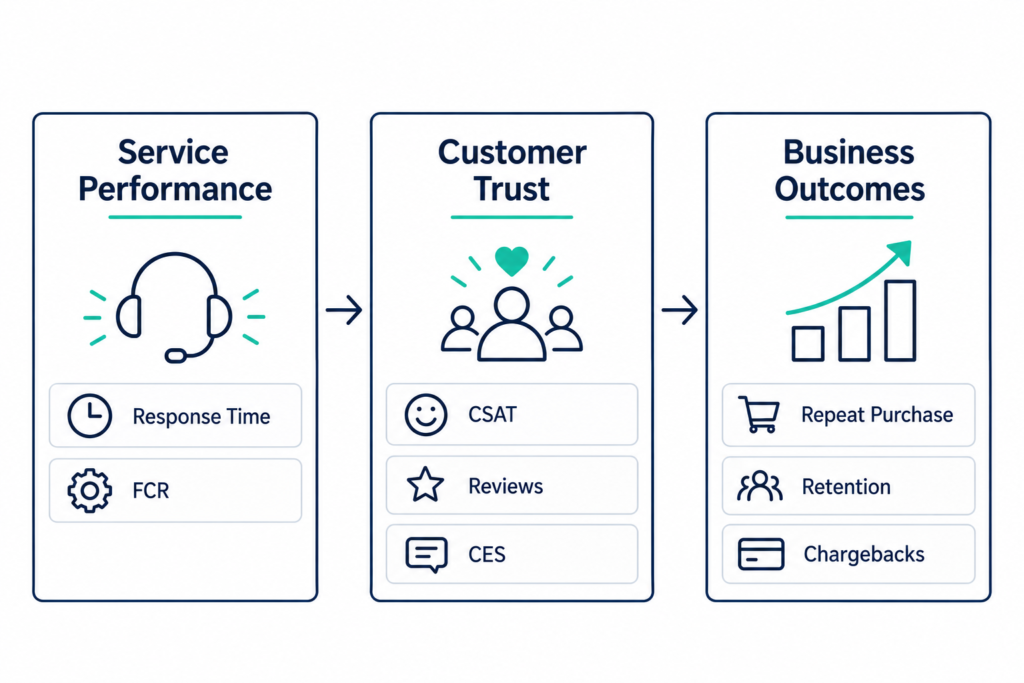
- CSAT by channel: segment by email, chat, phone, and social to find weak spots rather than relying on a single blended number.
- First Contact Resolution (FCR): SQM Group’s long-running contact-center research has found that every 1-point improvement in FCR tends to move CSAT by roughly the same amount, making it one of the most useful leading indicators available for satisfaction and, by extension, repeat-purchase likelihood.
- Repeat purchase rate: compare those who contacted support with a high-satisfaction resolution against those who didn’t.
- Refund, return, and chargeback rates over time, especially around a provider or policy change.
- Customer Effort Score (CES): high CSAT paired with high effort (long waits, repeated follow-ups) is a churn warning sign even when the satisfaction number looks fine.
Qualitative signals to monitor:
- Review language on marketplaces and Google mentioning “support,” “helpful,” “frustrated,” or “refund”
- Sentiment shifts after a provider transition or policy change
- Escalation volume (complaints reaching managers or legal teams)
Set up a joint scorecard, reviewed monthly or quarterly with your provider, that includes both operational SLAs and trust-related outcomes: chargeback trends, CSAT movement, repeat-purchase lift, and sentiment in reviews. Treat support measurement as a revenue function, not just an operational one. The connection between resolution quality and repeat purchasing is well established even if the exact multiplier varies by category.
Red Flags and Due-Diligence Questions to Protect Brand Trust
Use this as a practical checklist during RFPs, demos, and reference calls.
Red flags to watch for:
 No clear escalation path for complex issues or agent mistakes
Vague or undefined quality-review process
High agent turnover or heavy reliance on untrained contractors
Generic scripts that ignore your brand voice or policies
Poor transparency on data handling, sub-processors, or cross-border data flows
Due diligence questions that reveal depth:
 “How do you handle a clear mistake made by an agent?”
“What metrics do you track, and can I see recent data?”
“How do you ensure agent quality during rapid scaling?”
“How do you manage language and regional nuance across markets?”
“How do you decide when to refund vs. replace vs. deny?”
These questions are designed to surface whether a vendor is instilling confidence through genuine capability or through polished sales materials. The answers will tell you whether they can give customers peace of mind in the moments that matter most.
Making the Decision
By this point you should have three things in hand: your non-negotiables, a clear sense of which service model actually fits your ticket volume and communication needs, and a short list of due-diligence questions no vendor can answer with a generic script. That’s enough to identify real differences instead of just comparing hourly rates.
The providers worth shortlisting are the ones who treat that evaluation as an ongoing relationship to maintain, not a placement to complete. If a vendor’s answers keep circling back to speed and price rather than fit and continuity, that’s a useful signal that tells you which of the two questions they think they’re answering.
—————————————————————————————————————————
FAQs
How do I know when to outsource ecommerce customer service?
Common triggers include sustained ticket backlogs, CSAT falling below your own acceptable benchmark for more than a quarter or two, and leadership spending disproportionate time on operational firefighting instead of growth. E-commerce brands with meaningful order volume across multiple channels or geographies typically benefit from a specialized provider that can maintain a consistent customer experience at scale.
What is a reasonable budget for a trust-focused eCommerce support provider?
Costs vary by region, language mix, channel coverage, and compliance requirements. Offshore, capacity-based models cost less per hour; onshore or nearshore teams with native-fluency agents cost more. Rather than optimizing for the lowest hourly rate, evaluate cost against risk exposure. Brands with high average order values, subscription models, or regulated products should prioritize quality, security, and reliability over the lowest sticker price.
How long does it take to see an impact on customer trust after switching providers?
Most ecommerce brands see early leading indicators, such as CSAT, first response time, and queue lengths within 4–8 weeks. Deeper trust outcomes like improved reviews, higher repeat-purchase rates, and reduced churn typically take longer, often 3–9 months, to show up clearly. Set staged goals: operational stability in month one, measurable service improvements by month three, stronger loyalty indicators by month six and beyond.
Can AI-only support solutions protect brand trust as well as human agents?
AI chatbots and automation can meaningfully improve speed and consistency for simple, high-volume requests like order status or basic returns. Complex or emotional scenarios, such as defective products, billing disputes, and fraud concerns, still require human judgment to protect brand trust.
The most effective approach uses automation for routine tasks while trained (and well-matched) human agents manage exceptions, complaints, and nuanced issues. In those high-stakes moments, a support relationship either builds long-term loyalty or costs you the customer.
Sources cited in this article: Salesforce, State of the Connected Customer · Sift, Q4 2025 Digital Trust Index · Baymard Institute, Cart Abandonment Research · SQM Group, FCR Benchmarking